| |
|
 Ghosts
of the Past
Ghosts
of the Past
|

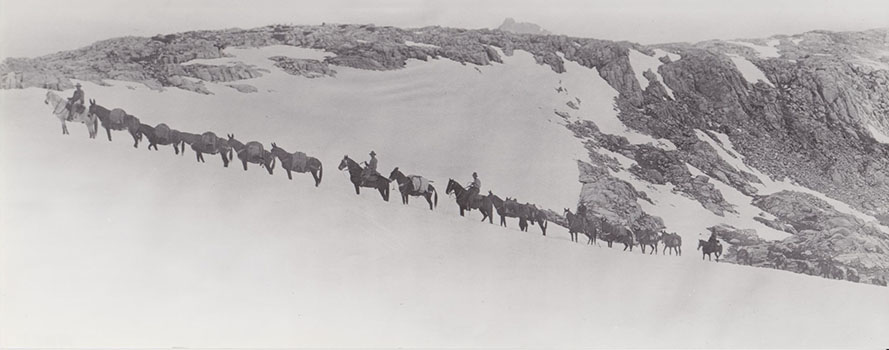 Packing in Golden Trout over Baxter Pass
(Department
of Fish & Game photo) |
The wild rivers and lakes of California are not entirely wild. Each year, as many as 50 million trout are planted in the state’s waterways. A fish caught on a multiday backpacking adventure could easily have been raised in a hatchery outside of Los Angeles. In the Sierra Nevada, less than 1 percent of large lakes would naturally host trout. Now, thanks to a century of fish stocking, over 60 percent do.
Before the
days of helicopters and fixed wing airdrops, fingerling Golden,
Brown, Rainbow, and Brook Trout were packed over snow covered
High Sierra passes in glass and metal containers on the backs
of mules. Earlier frontiersmen, miners and cattle drivers started planting trout in fish-less California waters as early as the late 1800s. Men would travel into the high country on horseback, lugging trout in 40-pound milk jugs to stock mountain lakes.The trout suffered a high mortality rate on their way
to the lakes and streams of the backcountry; but, without the
stamina and often times sheer guts of those packers, most of
the High Sierra would have been barren of trout up until the
1950s. Fishermen, backpackers, national park and forest service
personnel owe them an unending debt of gratitude for their contribution
to the "opening up" of the Sierra Nevada. To make all
of this, and more, possible most of the trail systems which exist
in the High Sierra were developed for the use of stock . Those
same national park and forest services now have all but banned that same stock from the High
Sierra. |
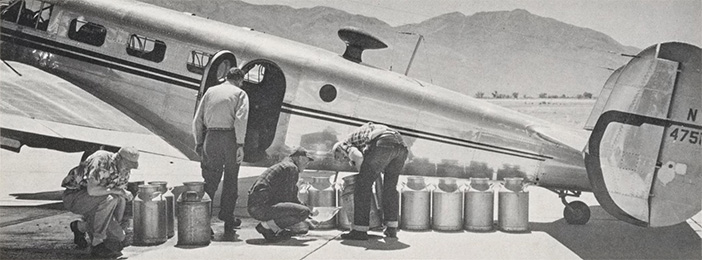 Planting fish by air
(Photo courtesy Inyo 1886 -1986) |
 09/24
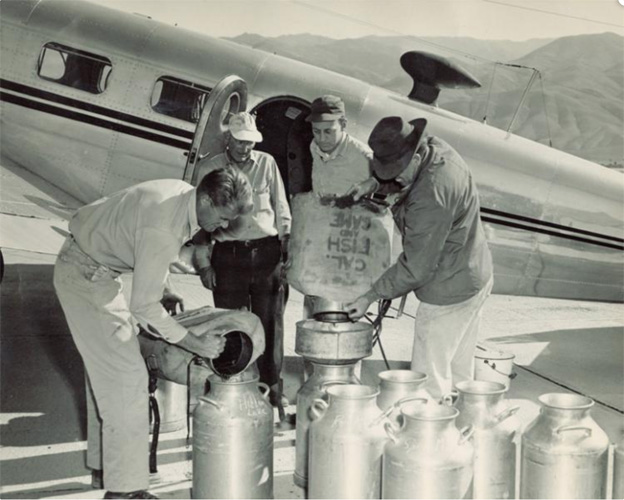 Loading trout fingerlings into cannisters for airplane dropping.
(Photo courtesy Anders Halverson) |
|
09/24
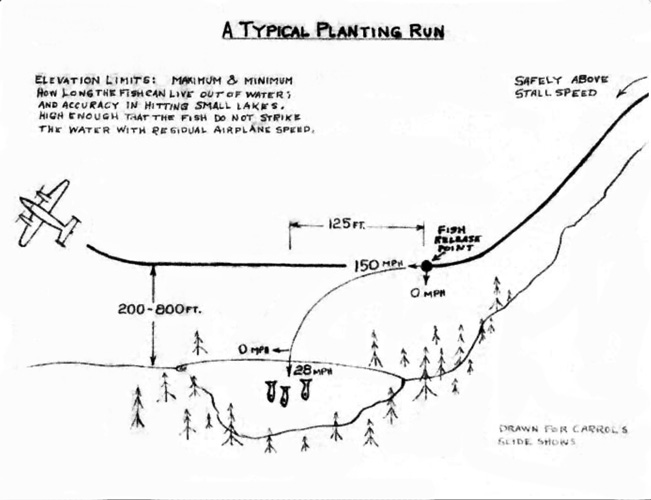 A typical airplane planting run.
(Photo courtesy Anders Halverson) |
09/24
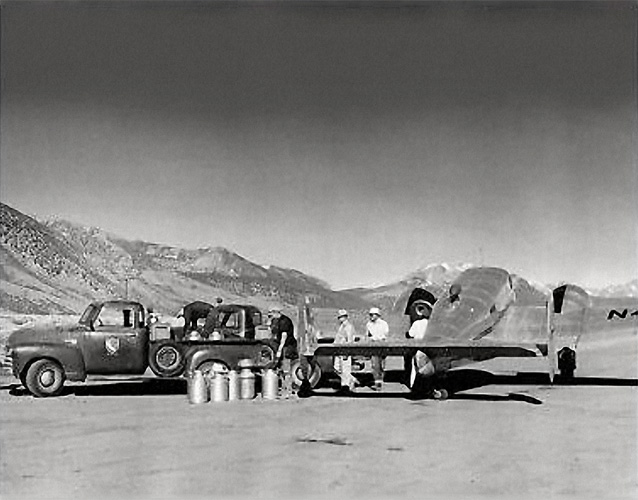 Loading trout fingerlings into cannisters for airplane dropping.
(Photo courtesy of ebay) |
Sherman Stevens' Cottonwood
Sawmill
|
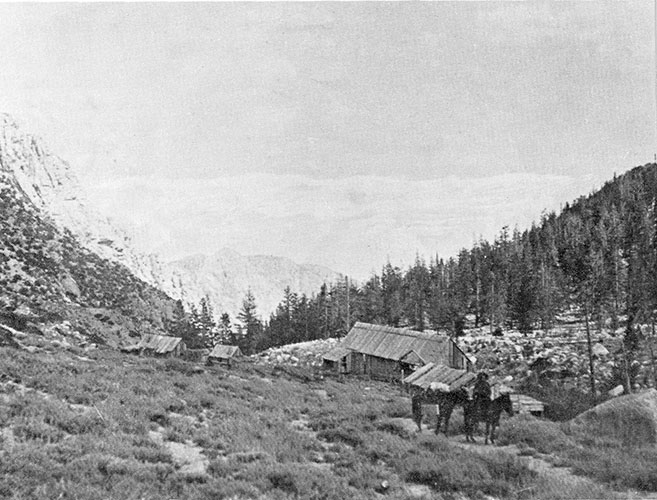
Sherman
Stevens Sawmill
[Bob Likes photo]
|
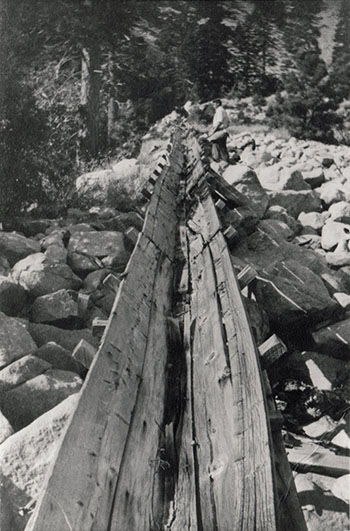 (Emil
W. Greitkeutz photo) (Emil
W. Greitkeutz photo)
|
Sawmill
and buildings
|
Mule facts
|
Log
sluice down Cottonwood Canyon
|
|
When
I first visited the sawmill in 1965 most of the mill was intact
minus the roofs of the buildings. Once the Horseshoe Meadows
road was put in (circa 1968), in less than 6 months vandals had
burned it to the ground. So much for the opening up of the Sierra
by the skiing establishment in an area that sported little or
no snow. This part of Owens Valley History had survived for over
sixty years when only pack outfits operating out of Carroll Creek
and Cottonwood Creek were its visitors. It was approximately
15 miles from here to the pack stations so only the hardiest
of backpackers made the trek besides the mule trains. All of
that changed with the road. History was burned, Cottonwood Lakes
were closed to fishing because of severe poaching, and giardia
was introduced to the streams of the area. What a terrible price
to pay for a road to nowhere.
|
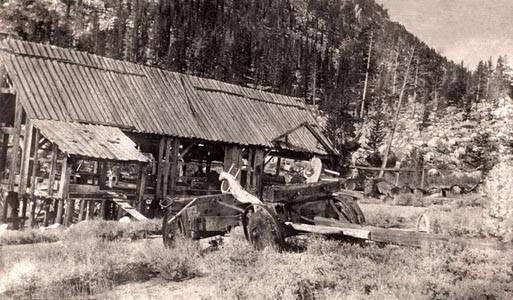 Sherman Stevens Sawmill at the head of Cottonwood Canyon
|
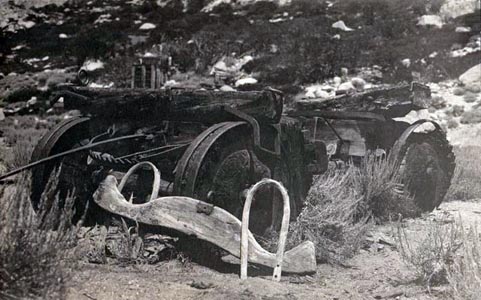 Old ox-drawn wagon at Sherman Stevens Sawmill
 |
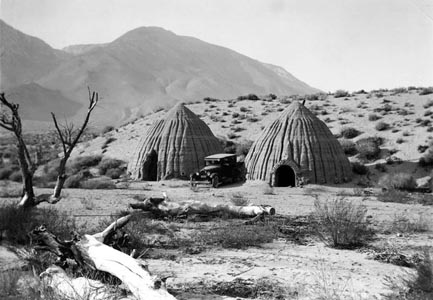 Charcoal kilns located on the banks of Owens Lake. Wood from Sherman Stevens sawmill was transported to the
kilns to produce charcoal which was used to fuel the smelters from the mines at Cerro Gordo. |
Don Andrews
of Monrovia, CA writes.
Thank
you for bringing back such great memories of Golden
Trout Camp. My uncle, John (Bud) O'Keefe purchased the camp
from Mr. Towler in 1949 and he and my dad ran it for the first
season, after which my uncle and aunt (Emma Jean) continued to
own and operate it until they sold to the present owners [Thacher
School]. I spent many summers working at the camp and tending
the many head of stock always present for the numerous guests.
I surely remember the brochure! I've probably seen hundreds of
them over the years. What stories I could tell of the many hair-raising
adventures us kids(my sister & two cousins)had during those
years. How sad the the fate of the sawmill, always considered
a welcome half-way mark during that long 4 hour horseback ride.
And the accompaning switchbacks on the trail! I have witnessed
whole pack trains go over the side when a packer failed to consider
the proper order in which to put the mules. Oh, the stories and
memories! Thank you for bringing a little of it back to this
58 year-old nostalgic.
Don Andrews - Monrovia, California |
Construction
of the Owens Valley Aqueduct
Only the
really old timers will remember scenes like the one to the right.
56 mule teams hauling huge sections of pipeline. Although the
construction of the Owens
Valley Aqueduct might have been an engineering marvel, it
was an ecological disaster for what is perhaps the most majestic
valley in all of California. Greed, power, and politics destroyed
one of California's greatest resources. This was merely the start
for El Pueblo de
Nuestra Senora la Reina de los Angeles del Rio Porciuncula. As she continued to grow legislative greed robbed the Colorado
and Feather Rivers of their water and then, to add insult to
injustice, returned to Owens Valley to rob the valley of its
ground water leaving the inhabitants with nothing more than a
dust bowl in what was once a rich agricultural valley.
Famed humorist, actor, statesman and cowboy Will Rogers said this about the aqueduct
in 1930: "Ten years ago this was a wonderful valley with
one-quarter of a million acres of fruit and alfalfa. But Los
Angeles had to have more water for its Chamber of Commerce to
drink more toasts to its growth, more water to dilute its orange
juice and more water for its geraniums to delight the tourists,
while the giant cottonwoods here died. So, now this is a valley
of desolation."
In W. A. Chalfant's book, The Story of Inyo, Morrow Mayo (a Los Angeles reporter)
wrote: "Los Angeles gets its water by reason of one of the
costliest, crookedest, most unscrupulous deals ever perpetrated,
plus one of the greatest pieces of engineering folly ever heard
of. Owens Valley is there for anybody to see. The city of Los
Angeles moved through this valley like a devastating plague.
It was ruthless, stupid, cruel and crooked. It stole the waters
of the Owens River. It drove the people of Owens Valley from
their home, a home which they had built from the desert. For
no sound reason, for no sane reason, it destroyed a helpless
agricultural section and a dozen towns. It was an obscene enterprise
from the beginning to end."
[L.A.
aqueduct 52 mule team photograph is from the Joseph
Barlow Lippincott Papers, LIPP, The Water Resources Center Archives,
University of California, Berkeley - LIPP 142:545] |
|
 Trail
Crest Junction on the route to Mt. Whitney, Guitar Lake, and
Consultation Lake
Trail
Crest Junction on the route to Mt. Whitney, Guitar Lake, and
Consultation Lake
(Sierra
Club Bulletin photo)
|
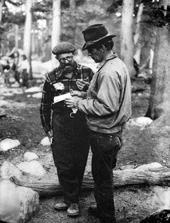 Gordon
Peterson on one of the Sierra Club High Trips
Gordon
Peterson on one of the Sierra Club High Trips
(Sierra
Club Bulletin photo)
|
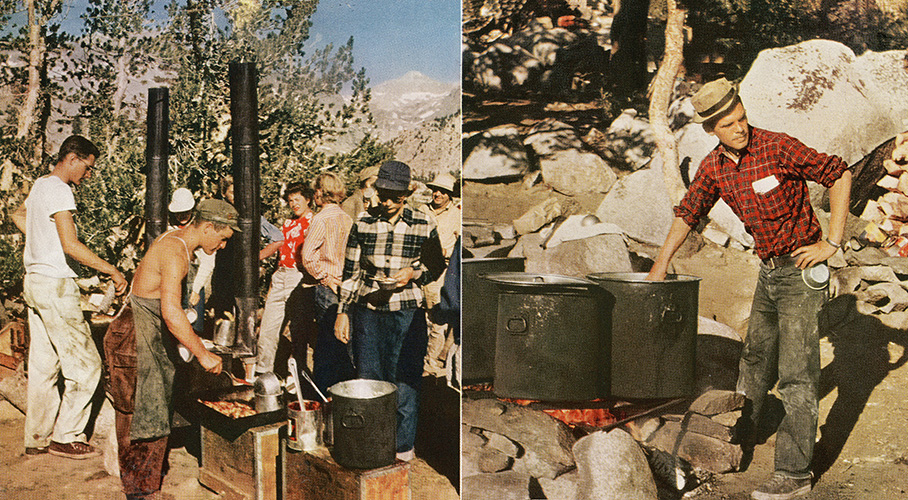 Sierra
Club cook and outdoorsman extraordinaire - Bob Golden
Sierra
Club cook and outdoorsman extraordinaire - Bob Golden
(June 1954
National Geographic photo) |
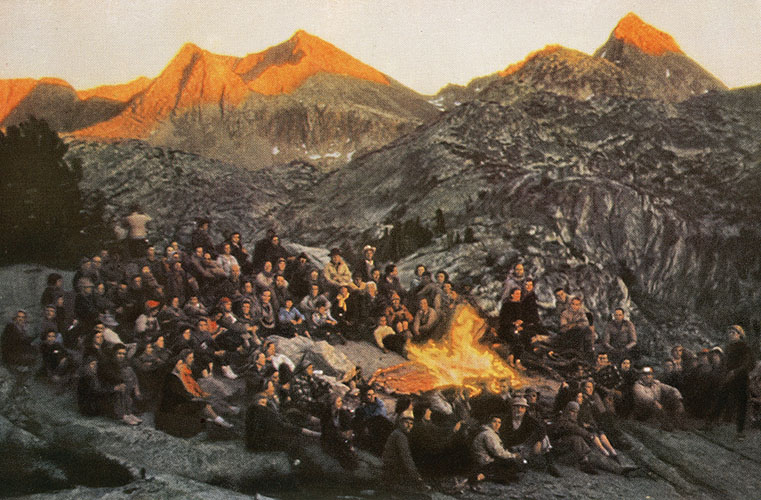 Sierra Club
"High Trip" Alpen Glow and Campfire atop Darwin Bench
Sierra Club
"High Trip" Alpen Glow and Campfire atop Darwin Bench
(1954
National Geographic photo) |
Informative
Owens Valley Links
|