
|
Lone Pine |
|
See USE NOTICE on Home Page |

 Owens Valley once was lush from the waters of the Sierra Nevada. Irrigation ditches built in the late 19th century by early pioneers on both sides of the Owens River watered pastures, dairy ranches, apple, peach and pear orchards, fields of alfalfa and corn, along with grape vineyards. In the mid 19th century Lone Pine had been called El Pueblo de las Uvas or the town of grapes by its Mexican setters. Mary Austin wrote a beautiful chapter in her Land of Little Rain that tells that story. Another settlement was called Manzanar, Spanish for apple orchard. Game abounded, such as deer, bighorn sheep, rabbits, quail, pheasant and other small game animals. In the early 1900's fish, such as golden and rainbow trout, had been transplanted from the western streams of the Sierra Nevada and were flourishing in the eastern mountain lakes, Owens River and its tributaries. (Excerpt from "Desert Padre: Life and Writings of Father John J. Crowley" by Joan Brooks) |
|
Images of Early Lone Pine |
||
|
|
|
 Stuck in the snow at the southern end of Owens Valley in 1924. |
|
|
|
 Stuck in the snow at the southern end of Owens Valley in 1924. |
 The Dow Hotel in the 1930s. |
 Main Street Lone Pine in the 1934. |
 Stuck in the snow at the southern end of Owens Valley in 1924. |


Photos from the Online Archive of California |
|
 Cottonwood Lakes and Old Army Pass |
 Crabtree Meadow and the western slope of Mt. Whitney in the background |
 An East Fork Lake near Lone Pine, CA - 1927 |
 An East Fork Lake near Lone Pine, CA - 1927 |
 Owens River near Lone Pine, CA - 1902 |
 The Great Western Divide from Lake South America - 1927 |
 Lake South America at the headwaters of the Kern River - 1927 |
 Lake South America at the headwaters of the Kern River |
 Lake South America at the headwaters of the Kern River - 1927 |
 Tulainyo Lake - the highest lake in the United States |
 Tulainyo Lake - the highest lake in the United States |
 Packers packing up Sierra Club dunnage near Old Army Pass |
 Packers packing up Sierra Club dunnage near Old Army Pass |
 Lone Pine Lumber, Lone Pine, CA - 1941 |
 Dow Hotel, Lone Pine, CA - 1902 |
 Lone Pine, CA - 1951 |
 Lone Pine, CA - 1938 |
 Lone Pine, CA - 1935 |
 Lone Pine, CA - 1928 |
 Lone Pine, CA - 1902 |
 Lone Pine, CA - 1902 |
 Lone Pine, CA - 1902 |
 Sierra Club dunnage traversing Old Army Pass |
 Sierra Club dunnage traversing Old Army Pass |
 Sierra Club dunnage traversing Old Army Pass |
 Golden Trout |
 Golden Trout from East Forks Lakes |
"Some Sierra Superlatives"
by Oscar Lewis
"A Near View of the High Sierra"
by John Muir
|
|
|
 This picture of the kids being packed into Monache by the Olivas'. PICTURED L/R: George "Wimp" Woods & Marilyn "Buzzy" Woods (children of Louise Olivas Woods), center unknown, and in the pack box to the right are Joe Ruiz and Margaret Ruiz, children of Ethel Ruiz Olivas. This picture had to be taken in the late 30's.s |
 The Olivas Pack Station in the 1930s when it was owned by Carmen Olivas. Mounted - L/R: George Woods and Louise Olivas Woods. |
 Ally Robinson and Wendell Gill |
|
 Delphina Olivas cooking on a movie set in the Alabama Hills, Lone Pine, CA |
 Leaky Olivas flipping flapjacks at the Olivas Cow Camp |
 Chuck wagon headed for the movie set in the Alabama Hills. Delphina Olivas second from the left. |
|
 Pete Olivas at the Olivas Pack Station |
 Petra Diaz Olivas |
 Carmen Olivas at his house in Lone Pine where the Olivas Pack Station was located |
 Carmen Olivas |
 On the Hopalong Cassidy set in Lone Pine - circa 1950s |
|
 Old Lone Pine Elementary School picture. Ethel Dearborn (tall woman in the back row) Louisa Olivas (2nd from the right in the back row) |
|
Photocards below courtesy of Rich McCutchan |
|
 Lone Pine in the early 1900s |
 Lone Pine in the early 1900s |
 Lone Pine in the early 1900s |
 Owens River in the early 1900s |
 Lone Pine Railroad Station |
 Lone Pine in the early 1900s |
 Christofferson tractor Biplane in Lone Pine in 1914 |
|
 The Miller Ranch in 1914 |
 Lone Pine in the early 1900s |
 Dow's Hotel in Lone Pine in the early 1900s |
|
 Santa Rosa Church in Lone Pine. |
 Lone Pine Drug Store and Post Office |
 Lone Pine in the 1940s |
|
 Lone Pine in the 1940s |
|
 Lone Pine in 1943 |
|
 Lone Pine CCC camp. |
|
 Lone Pine in 1947 |
 Lone Pine in the 1940s |
 Lone Pine in 1949 |
|
 Lone Pine in 1949 |
|
 Lone Pine in 1947 |
|
 Lone Pine in the winter of 1946 |
 Lone Pine railroad depot |
 Lone Pine railroad depot |
|
 Lone Pine in 1917 |
 Smitty in Lone Pine |
 Welcome to Lone Pine |
 Lone Pine in the early 1940s |
 20 Mule team painting by cowboy artist Ed Thistlethwaite. Painted from memory as it was in the 1880's when the team was owned and operated by the Pacific Coast Borax Company. Pilot Knob in the background was a landmark on the old trail from Death Valley to Mojave, which at that time was a 16 day trip. |
|

 The Roxie Theater in Lone Pine - 1926 Located at the corner of S. Main Street and Post Street Lone Pine Hall Movies was listed on Sanborn Maps 1928 at Bush Street and Jackson Street, or today 138 N. Jackson Street. On July 15, 1929, The Three Gumm Sisters performed at the Lone Pine Theater, which would make the future Judy Garland seven years old at the time. Film Daily Year Book 1926 lists the theatre with 200 seats. In 1931 it was joined in town by the ‘New Lone Pine’ theater, later listed in 1932 as the Roxie Theatre. The site is currently occupied by Statham Hall, serving as city hall, community and senior center. [Photo courtesy of Cinema Treasures] |
 The Whitney Theater in Lone Pine - 1948 The March 1, 1924 issue of Motion Picture News listed Lone Pine Hall as one of the Southern California locations at which new Simplex projection equipment had recently been installed. Both Lone Pine Hall and the New Lone Pine Theatre were mentioned in the December 6, 1930 issue of the Big Pine Citizen. The October 3, 1932 issue of the Citizen said that the mystery thriller Dr. X would play at the Lone Pine Hall Theatre on October 4th, 5th, and 6th. A July 23, 1932 Citizen article noted that Ray Pierson had leased the Lone Pine Hall in 1930. He was still operating the house in 1932. Mentions of Pierson (sometimes with the variant spelling Pearson) as operator of the Lone Pine Theatre appear in trade journals through the 1930s and 1940s, one in the May 29, 1948 issue of Motion Picture Herald, not long after the same publication noted that Western Amusement Company was building the new house that would open later that year as the Whitney Theatre. I haven’t been able to discover if the Lone Pine continued in operation after the Whitney opened. [Joe Vogel - May 23, 2021] [Photo courtesy of Cinema Treasures] |
 06/26
06/26Photos and text courtesy of Dick Mayorgas |
|
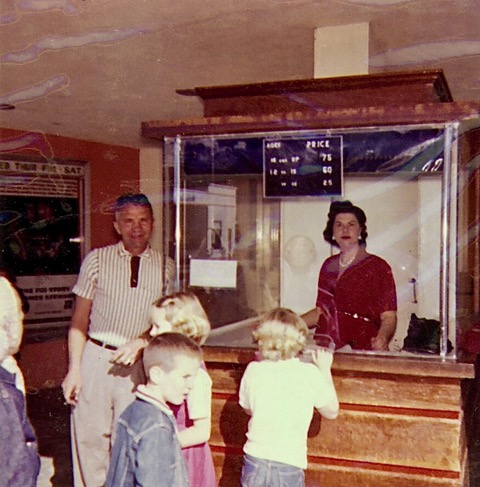 Inside the Whitney Theater in Lone Pine - 1960s L/R: Dexter Wright (Theater Manager), Bonnie Stall (Dick's mom). |
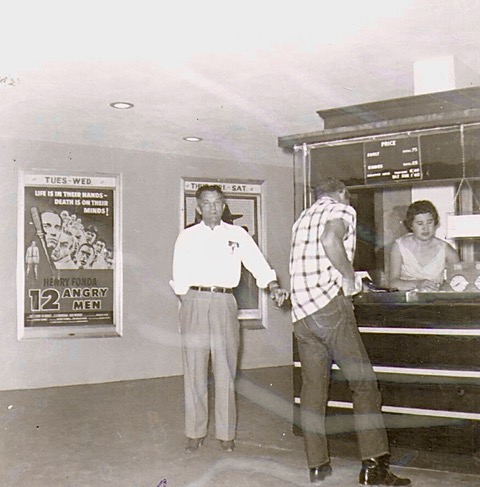 Inside the Whitney Theater in Lone Pine - 1960s L/R: Dexter Wright (Theater Manager), Bonnie Stall (Dick's mom). |
Ray, Here’s a story that I posted, in April 2025, for a group that I belong to - (most of it, you’ll recognize) |
|
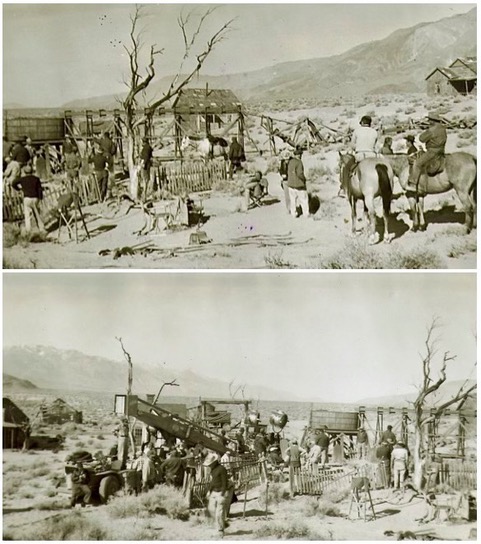 On the set of The Law and Jake Wade |
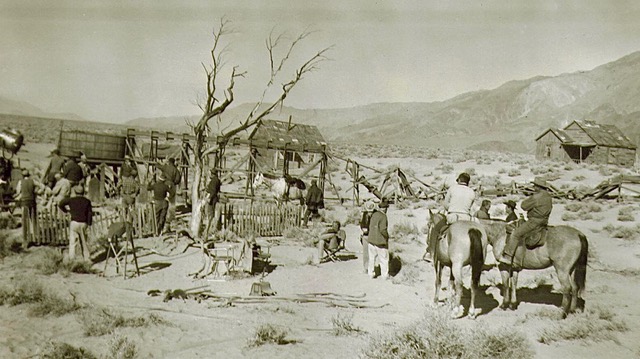 On the set of The Law and Jake Wade |
 Vintage photograph of Lone Pine [Photo courtesy of Page Williams] |
 Vintage photograph of the Owens River south of Lone Pine This is a movie still from the Tom Mix movie "Just Tony" (Alternate: A) [Photo courtesy of Page Williams] |
 Vintage photograph of the Owens River taken by Fred Eaton before the Los Angeles aqueduct was constructed [Photo courtesy of Page Williams] |
 Lone Pine, CA |
 Lone Pine, CA |
 Mt. Whitney Cafe - Lone Pine, CA |
 Mt. Whitney Observatory - Lone Pine, CA Another photo - Courtesy Inyo County Sesqquicentennial In the 1920s, William Charles Probasco owned a restaurant in Lone Pine. A pretty decent amateur astronomer, he built the domed roof and placed a telescope inside, to view not only the stars and moon, but also people on Mt. Whitney. It is said many pictures were taken through the telescope documenting people making it to the summit of Mt. Whitney. Probasco passed on and the telescope was sold to Ellis Sterling who owned a gas station in town. The telescope continued to be used for viewing the sky and Mt. Whitney for a number of years. - Rick Olson |
 Lone Pine, CA |
 Dow Hotel - Lone Pine, CA |
 Bicentennial team leaving Lone Pine, CA |
 RKO Dunga Din encampment - Lone Pine, CA |
 Willow Motel - Lone Pine, CA |
|
 Mt. Whitney / Death Valley Highway Celebration - Lone Pine, CA |
 Mt. Whitney / Death Valley Highway Celebration - Lone Pine, CA |
 Motel Dow Villa - Lone Pine, CA |
|
 Alabama Hills movie set - Lone Pine, CA |
 Alabama Hills, Tuttle Creek Road - Lone Pine, CA |
 On the trail to Mt. Whitney from Hunters Flat (before the road to Whitney Portal was constructed) (Photo courtesy of Inyo County Sesquencentennial) |
|
 Spear's Lone Pine Pack train at Golden Trout Camp on the way to Cottonwood Lakes (Photo courtesy of Inyo County Sesquencentennial) |
|
 Corral Cafe and Bar - Lone Pine, CA (Ebay posting) |
 Mt. Whitney Pack Train on the trail over old Army Pass (Sierra Club Magazine photo) |
03/21 On a movie set in the Alabama Hills (Photo courtesy of Tales Along El Camino Sierra) |
 First Easter Sunrise Services at the Foot of Mt. Whitney (Photo courtesy of Inyo County Sesquencentennial) |
10/22 Here's a book featuring stories by George Putnam (husband of Amelia Earhart) about Lone Pine and the Mt. Whitney area from their home in Whitney Portal (formerly owned by Fr. Crowley) (Photo courtesy of Rich McCutchan) |
07/21 Dow Hotel advertisement (Advertisement courtesy of Bob Pilatos) |

 10/22
10/22"Buried Treasure"
by George Palmer Putnam
"Fugitive"
by George Palmer Putnam
"High Garden"
by George Palmer Putnam
"Lone Pine"
by George Palmer Putnam
"Picture Country"
by George Palmer Putnam
11/23 Eastside Beer truck - 1948 (Photo courtesy of USC Digital Library) |
 Looking towards Owens Lake from the Whitney Portal Road - 1948 (Photo courtesy of USC Digital Library) |
 Diaz Lake - 1948 (Photo courtesy of USC Digital Library) |

 |
Packing & High Sierra Stories | |
|
|
Mt. Whitney Packers of the 40s - 70s | |
|
|
More
Early Lone Pine |
 |
|
Wildflowers of the High Sierra |
|
|
|
One Packers High Sierra Experience |
|
|
|
Vintage Eastern High Sierra Brochures |
|
  Sign Guestbook View Old Guest Book Entries Oct 1999 - Feb 2015 (MS Word) |
 CONTACT the Pigmy Packer |
 View Guestbook View Old Guest Book Entries Oct 1999 - Feb 2015 (PDF) |
 This page was last updated on
21 June 2026
This page was last updated on
21 June 2026