|
 |
"Night
Ride"
by the Sequoia-King
Pack Train's Slim Randles
|
|
The "Night Ride" is courtesy of Slim
Randles. Slim packed with for Gene and Lona Burkhart out of Sequoia-King
Pack Trains (Onion Valley) from 1958 through 1968. But not every
year. Usually, though, he'd quit his reporting job about the
time the sun started opening those passes!
Thanks for allowing me to use your article Slim!!
You can obtain Slim's story and other stories of the west in
the new book: "Hot Biscuits: Eighteen Stories by Women and
Men of the Ranching West " by Max Evans Candy Moulton, published
by the University
of New Mexico Press.Hot Biscuits can be purchased either through the University of New Mexico Press or Amazon.com.
|
|

 |
Attention
all of you High Sierra packers!
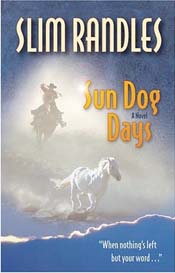
Sun Dog
Days is book
you DO NOT want to miss reading. Slim Randles has masterfully
captured the life of two Owens Valley packers, Buck and Smokey,
and their adventure, not only in the Coso Mountains but their
adventure in life. It is a heartwarming story which will challenge
your emotions as you reflect on those days when you were once
a packer yourself.
Slim has informed me that he is working on the screenplay to
his book and it will soon be made into a motion picture. When
it is, I hope that all of you former and current packers will
do the High Sierra packing business the honor of seeing the movie.
Sun Dog Days is available at www.amazon.com
|
|
The magic crescendo of day's end took forever to come, but
it finally happened. The packer could look up to the west, above
the tired ranch house, above the shady, whispering black locust
trees along the alfalfa fields and see the peaks of the eastern
Sierra transform.
From the hazy-hot mountain range of the summer day, the peaks
now became vertical battlements backlit by the flooding of a
setting sun. Each snowfield seemed larger at this time of day.
Each peak strained upward through the sun blasts as if to declare
their sovereignty before night cloaked them in mystery.
And the packer saw, as well, the blazing Inyo Mountains to
the east, lit with the burnishing brush of evening, the rock
spire of the Paiutes' sacred Winnedumah now absorbed by the mountains."Chores done?"
It was the boss.
He nodded.
"Can't eat the scenery," the boss said, chuckling.
"Get some food. Time to go."
It was already getting dark when he began the saddling. Five
horses, six mules. He tied the stirrups over the saddle seats
with the saddle strings on the horses and checked each animal
for shoes. Then he strung them together, being careful to get
the right order.
You led the horses and tied the mules on behind. If you had
trouble with the stock, he knew, it would come from the horses,
not the mules. You led first the slowest horse, then the ones
who caused you trouble, then the good horses, then the slowest
mules, then the faster mules. Each collection of stock required
some thinking before it became a functioning pack string.
"Lead ol' Jim," the boss said, unnecessarily. "He's
the slowest. Always lead the slowest."
The packer nodded and ran lead ropes through the stirrups
hanging on the near side of the saddles, and then tied large
bowlines around the necks of the next animals. Six mules first,
then the mules to the horses and finally to ol' Jim. One by one
in the alkali dust and saltgrass smell of the big corral until
there were eleven head in one long string and ol' Jim's lead
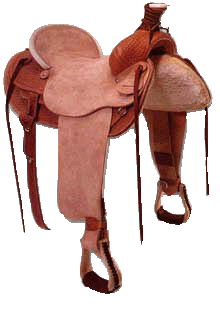
rope was dallied to the horn of his own rough-out saddle sitting
on Brownie.
It was going to be another of those nights. Another of those
special nights, he knew. Another gem in the necklace of a life
he hoped would become heavy with such treasure. He realized he
wasn't talking tonight, except for a few words to each animal
in the string as he worked on them. It made him smile, because the packer
was naturally talkative, but talk could only profane a night like this, and
he needed this night to be pure. Being silent was this mule packer's
attempt at religious sacrifice. He would never say anything about
it to the boss or the other guys in the bunkhouse, though. If
any of them had similar thoughts, they wouldn't talk about them.
There is an unspoken holiness in silence.
He tied his jacket behind the cantle, despite the sweaty hot
evening and its brassy taste. He knew the winds coming off Kearsarge
would bite deeply before he reached the pack station up there
in that blackening canyon at 9,200 feet above sea level.
The boss stopped traffic on the highway as the packer rode
Brownie and led the jittery, trotting string of animals across
the pavement and up the start of the dirt road through the sage
toward the night fastness above him. And then it was quiet, but
for the footfalls of the horses and mules as they once again
figured where their places were and what their speed should be
and turned from a herd of tied-together animals into a pack string.
 |
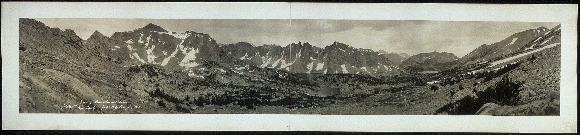
The Kearsarge Pinnacles
|
As the road became a trail, and the trail went up into
the mountains, the packer could look back at the ranch lights
at the fort, and then look the two miles farther down the valley
along the light-string of headlights to the town lights of Independence,
his adopted home. It's strange how those lights mean so much,
huddled together in the face of such awe, gathering as if for
company and support against the overwhelming mountains and the
secrets of the night. He became aware of the moon only gradually,
as he realized an hour later that he could make out Brownie's
ears before him. Then he turned back to see each silvery animal work the slow switchbacks in turn, and he
paused each animal length ahead of them to let them make the
corners. There is a thrill and a pride in handling a really long
string of stock, he thought. During the days in the high country,
he seldom had more than five or six head behind him. But a man
who can handle a pack train this long has reached the elite status
of packer in this eastern rugged tall-nasty High Sierra country
of California. A string like this one, on a moonlit night, alone,
can earn a packer a doctorate in this unique craft.
During each of the summer days, he led the mules and took
the dudes over the rocky, wind-snapped passes to the fishing
lakes. He chatted with the people, reset errant horse and mule
shoes, enjoyed the scenery. But these night rides were special.
The boss's stock truck could climb the switchbacked dirt road
to the pack station in the meadow they called Onion Valley, but
not if it had any stock in it. So on the days when some of the
stock wasn't needed for the high trails, it was taken down to
the ranch in the stock truck where grazing was a lot cheaper
than feeding alfalfa.
And when the time came to go back to the mountains, the packer
had to ride at night to return them "up the hill" for
the next day's work. This meant riding all day, riding all night, then riding all
day again, but it didn't happen often and the packer didn't mind
that much, really. There were things on the night ride, he knew,
that somehow paid the ticket for the fatigue .And it made him smile. The stock didn't seem to misbehave
as much at night, either. Maybe they, too, sensed what he did,
that this was somehow a privilege and not just another long,
dusty trail up the mountain.
At Tubbs Springs, he tied the string to an oak and went down
the string, one by one, checking cinches, whispering reassuring
words, making certain no saddle pads had slipped. Four cinches
needed tightening. Not bad. The percentage was getting smaller
each trip, he thought, and he felt pleased.
Then he swung back aboard Brownie, picked up the lead rope
to Jim and yelled "Mules!" and they obediently swung
into line again and headed for the brushy saddle known locally
as Tubbs Summit.
By this time, the moon turned the horses and mules silver
with its magic. It gave the packer an unspoken pleasure to look
back on a sinuous Sierra snake of eleven animals stretched in
a flexible line nearly 150 feet long behind him. And he looked
up, straight up on the peaks of Kearsarge where the snow fields
always left behind shady patches of dirty white, up where the
Inyo moon splashed them with a dream brush and made old secrets
come to life.
"You've heard of the ghost of Kearsarge," the old
man said. "Everyone knows about her."
The packers at the table at the ranch looked at each other.
"What ghost?" one asked.
"Just the old lady," the old man said, with laughter
in his dark Paiute eyes. "She doesn't hurt nothing, you
know. Just sings a little."
The evening was dark at the ranch, and the table lamp splashed
shadows of the assembled weary cowboys on the kitchen walls as
they sipped coffee. It was always good to hear the stories the
old man told, coming over from his own small cabin here on the
reservation.
"I never heard nothing about a ghost lady up Kearsarge,"
said the cook.
 "That's what they say." said the old man. "Ever
since there was a town up there. Used to be the mine up there,
you know. Big one. Then there was a big dance in town one Christmas
time, it was. Long time ago. Before my time. "That's what they say." said the old man. "Ever
since there was a town up there. Used to be the mine up there,
you know. Big one. Then there was a big dance in town one Christmas
time, it was. Long time ago. Before my time.
"Anyway, everybody went to Independence to dance, you
know, except the caretaker and his wife. Avalanche got 'em. They
were the only ones. Everybody else went to the dance. Can't remember
what year it was. That mine was working then, though."
Nobody spoke while the old man sipped some coffee. "You
boys ever hear her up there at night? You can hear her, that's
what they say, anyway. Avalanche took her head off, you know.
Never did find it. They say she calls for her head at night when
there's a moon."
"At Kearsarge?"
"Yeah, you know where those old foundations are? That's
where the little town used to be. Where the stock trail leaves
the Onion Valley road. Looking for her head. That's what they
say. Looking for her head."
The first foundations of Kearsarge glowed in the moonlight,
little more than deliberate rock piles and scattered timbers
now. The packer steered Brownie around the first and left the
little stretch of dirt road again to follow the creek up the
canyon. More foundations glowed, their old stones like ageworn
teeth, and the wind came down from the snow patches cool and
quiet. The packer thought he heard something, once. Just once,
but he wondered about it, anyway. Looking back, the cluster of
lights that was Independence had now shrunk to a small glowing
nucleus in the moonscaped miles below.
He rested the stock on the first switchback above the old
ghost town and pulled on his jacket. It helped.
"Your granddad told us there was a spook up at old Kearsarge,"
the packer said as they walked along the irrigation ditch that
one night.
"Grandpa knows a lot," she said, squeezing his hand.
"It's probably true."
He saw her eyes then, in the glow of a nearby streetlight
there in town, as they walked. The desert night warmed them and
made them both think of things long past and yet to come.
"You don't think he was just trying to b.s. us into being
scared?"
"Not Grandpa. He knows a lot."
"Umm," the packer said."You like him?"
"Sure. Great guy."
"He likes you, too. He likes you a lot, I know. So does
my mom and dad."
"Very nice people, your mom and dad."
She smiled up at him and he could see the pretty eyes again,
the ageless eyes that spoke so much of generations of desert
and mountain people, despite her youth.
"You like kids?" she asked.
The creek crashed down the mountain, heading for its ignominious
ending in the Los Angeles aqueduct far below. The packer took
the rocky crossings slowly, stopping often. The longer the string,
the slower he must go, until every part of this long silent snake
had negotiated every obstacle smoothly. Brownie was used to the
stop and go of the night rides with long strings and didn't argue.
And there was the magic, of course. The seductive sorcery
of night in the place where desert collides with mountains. It
makes the longest nights shorter and the hardest rides easier.
He found the first of the pine trees at about 8,000 feet and
listened once more to the breeze in the needles. Most of the
horses were eager to get to the corrals and the hay, but the mules seemed content to look for moon-splashed grass clumps
along the trail, clumps they may have missed on the last night
ride.
The packer looked back each time the trail offered a view
of the long string behind him. The saddle horns on the horses
and the forks of each pack saddle seemed to be straight up. No
one was hanging back on their lead ropes. No one had stepped
over one. He could see this clearly, all the way back to the
caboose mule. Sometimes he felt like the engineer on a train,
except that each of his boxcars had a mind of its own.
Then, as the peaks surrounded them in moon shadow, the wind
turned cold and the weariness hit. He pulled his hat down farther
on his face, turned up his collar, and shamefully admitted to
himself that he looked back less often.
The moon was behind the crest of the Sierra as he rode Brownie
into the blackness of the pack station yard. The boss was there
to help him unsaddle.
"Everything go okay?"
"No problems," the packer said.
"By the way, happy birthday."
"That's right, isn't it. Thanks."
"How old are you now?"
The packer stopped to think for a second in his early morning
weariness. Then nodded.
"Seventeen," the packer said.
Outdoor novelist and hunting guide Slim Randles
spent eight summers in the eastern
High Sierra packing mules for Sequoia-Kings Pack Trains.
 |
|
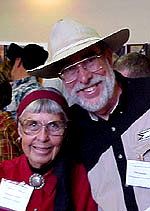
Slim Randles
& Lona Burkhart 1995 |
Burkhart ranch
in Oregon
1, 2, 3 |
|
Richard
Leach from South Jordan, Utah Writes. |
Ray,
I phoned Lona Burkhart this morning and she mentioned this web-site.
It is hard to believe, but all the horses and all the mules that
Slim and I knew are all dead now. They've been gone for decades.
So has Gene Burkhart. Very sad. Don't mean to sound somber. I
suppose this is why we need authors to record the memories. Those
mountains are still there and though my memories of them still
linger in the old trails of my mind. I must be content now to
view the Wasatch Front in Utah. They're nice too, but not quite
as grand as the east slope of the Sierras. Slim always wanted
to earn a living writing and thank the Lord he can.
Mr. Randles has been a colorful character and I emphasize the
word character. He's been a good friend and I am glad to have
known him. Slim and I shared the trails together to be sure,
but mostly we packed apart. What we share most is a lifelong
love for the Burkharts. Gene was a tough one to know as I'm sure
Slim will attest. Even so, we learned to love him a second father.
He was stern with us boys, but he was fair and usually right.
He taught me a good deal of what has got me through this life.
Then there is Lona. She was always so easy to talk to. Slim and
I grew very close to her and we both count her amongst our very
best friends. I suppose she must be our godmother!
I decided it might be fun to relive my past a few years ago and
I purchased a colt from Lona up in Oregon. I brought it home
gentled it down and had it broke. Well, about the third time
I fell off I decided I'd had enough of reliving my past. Maybe
I should have named that quarter horse something other than George
W. Oh well, so I found a good home for G.W. and now I spend my
time telling stories to my grandkids about what a great cowboy
I was. And because I'm their grandpa, they believe everything
I tell them. Well, at least I do have my memories.
Thanks Slim!
Richard Leach
January 2008 |
Other Books Written by Slim Randles
Dogsled,
A True Tale of the North, Winchester Press, 1977
Hell,
I Was There! (Life Story of Elmer Keith) ghost writer,
editor and designer. Petersen Publishing, 1978.
The
Long Dark, An Alaska Winter's Tale, Alaska Northwest
Publishing, 1984. (First novel published in Alaska).
This
Chosen Place (contributor) by Max Evans, University Press
of Colorado, 1996.
Raven's
Prey, McRoy and Blackburn, 1998. (novel)
 ABE Books, making "out
of print" books easier to find. ABE Books, making "out
of print" books easier to find. |

|