|
|
 |
One Packer's
High Sierra Experience |
|
All
pictures are from the archives of Ray DeLea unless otherwise
noted.
|
Revised- May 2020: High Sierra Adventures
Added endorsements and poem, expanded Foreword, needed format enhancements. |
|
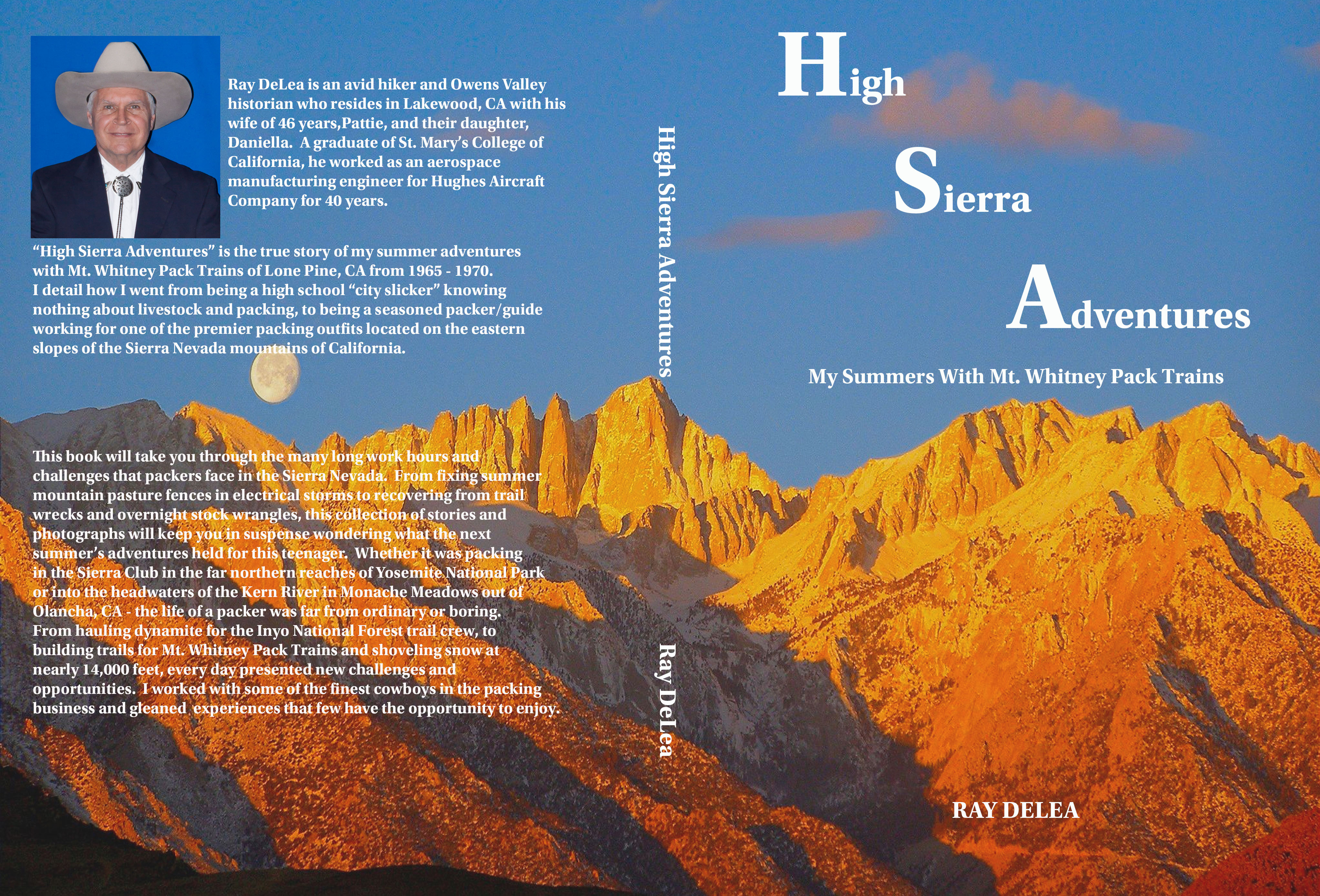
| This book follows the adventures of a teenager who worked for Mt. Whitney Pack Trains, out of Lone Pine, CA, for six summers between the years of 1965 - 1970. It details his journey from being a "city slicker" knowing nothing about livestock and packing to becoming a seasoned packer / guide for one of the most prestigious pack stations operating on the east side of the Sierra Nevada. Using a combination of photographs and life events he takes the reader progressively through six summers of "learning the ropes" of being a packer as he packed in such groups as the Sierra Club, the Trail Riders of the Wilderness and private parties. This book is full of events that will make you laugh and cry as he describes the pack trips, wrecks, wrangles, livestock and personnel that made each summer a greater adventure than the preceding one. |
Copies are now available through Amazon
The Western Museum of Film History in Lone Pine, CA
The
Eastern California Museum in Independence, CA
and at the Whitney Portal Hostel & Hotel in Lone Pine, CA |

Olancha Pass Trail
In this picture
you can see Olancha Pa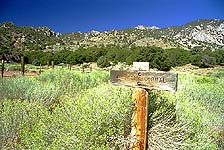 ss. It is the first saddle to the right
of the peak (Round Mountain) on the far left of the picture.(Olancha Peak is the
highest peak just to the right of center in the picture.) I packed over this pass some three or four times that I recall.
Once while wrangling for some lost horses with Frosty Frost in
the fall of 1970. I never put on more miles in the saddle in
a week than that week spent with Frosty. Frosty was in his sixties,
at least, and I had just graduated from St. Mary's College. He
was looking for someone to help him out wrangling. I had just
finished up the summer with Tommy at Mt. Whitney Pack Trains
and was looking for work. Work found me trying to track lost
horses amid thousands of fresh tracks in Monache, Little, Big,
Redrock, Cold, Beer Keg, Casa Vieja, and Osa Meadows. Some sixty
hours of riding in the saddle, for each of us, produced nothing.
I seemed to recall Frosty mentioning one Christmas at Tommy &
Barbara's that the stock eventually showed up at Kennedy Meadows
some distance to the south. This trip had one really BIG bright
spot in it - we made our base camp at Jordan Hot Springs on Nine
Mile Creek. Being Fall, Jordan Hot Springs Resort was closed
for the season and Frosty and I had the entire camp to ourselves.
There was plenty of food and after each dusty day we were able
walk buck naked from the camp down to the the bath tubs which
were fed by hot springs in the Nine Mile Creek area. Since the
tubs were fed by the hot water of the springs, we had to make
several trips to the creek with a bucket to lower the water temperature
to a bearable level. Frosty and I had a great time that fall
"wrangling for ghosts." We weren't "Ghost Riders
in the Sky" but certainly so on the ground! Frosty and his
wife operated a farm in the San Joaquin Valley and I they always
brought some of the best corn to Tommy and Barbara's. ss. It is the first saddle to the right
of the peak (Round Mountain) on the far left of the picture.(Olancha Peak is the
highest peak just to the right of center in the picture.) I packed over this pass some three or four times that I recall.
Once while wrangling for some lost horses with Frosty Frost in
the fall of 1970. I never put on more miles in the saddle in
a week than that week spent with Frosty. Frosty was in his sixties,
at least, and I had just graduated from St. Mary's College. He
was looking for someone to help him out wrangling. I had just
finished up the summer with Tommy at Mt. Whitney Pack Trains
and was looking for work. Work found me trying to track lost
horses amid thousands of fresh tracks in Monache, Little, Big,
Redrock, Cold, Beer Keg, Casa Vieja, and Osa Meadows. Some sixty
hours of riding in the saddle, for each of us, produced nothing.
I seemed to recall Frosty mentioning one Christmas at Tommy &
Barbara's that the stock eventually showed up at Kennedy Meadows
some distance to the south. This trip had one really BIG bright
spot in it - we made our base camp at Jordan Hot Springs on Nine
Mile Creek. Being Fall, Jordan Hot Springs Resort was closed
for the season and Frosty and I had the entire camp to ourselves.
There was plenty of food and after each dusty day we were able
walk buck naked from the camp down to the the bath tubs which
were fed by hot springs in the Nine Mile Creek area. Since the
tubs were fed by the hot water of the springs, we had to make
several trips to the creek with a bucket to lower the water temperature
to a bearable level. Frosty and I had a great time that fall
"wrangling for ghosts." We weren't "Ghost Riders
in the Sky" but certainly so on the ground! Frosty and his
wife operated a farm in the San Joaquin Valley and I they always
brought some of the best corn to Tommy and Barbara's.
Another time I packed a Sierra Club trip over Olancha Pass with
several packers from MWPT. The trip was originally intended to
go out of Horseshoe Meadows over Cottonwood Pass and into the
surrounding backcountry. Unfortunately the snow was too deep
and forced the trip 30 miles to the south over Olancha Pass.
The same scenario play itself out again on a Trail Riders of
the Wilderness trip. This trip usually went in over New Army
Pass from the Cottonwood Lakes basin and came out over Trail
Crest, with a saddle trip to the summit of Mt. Whitney, and down
to the corrals at Whitney Portals. This trip was always the last
big "all expense paid" trip of the summer for the outfit;
so it was unusual for that much snow to still be on Trail Crest
Pass in mid August - but anything is possible with a pass that
is 13,777' high. So off we were again over Olancha Pass, through
Monache Meadows and north through Brown, Strawberry, Templeton,
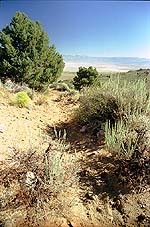
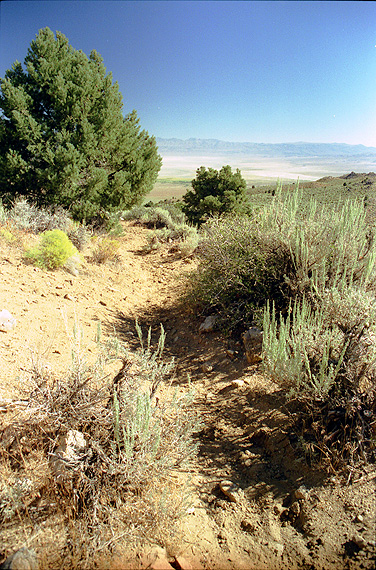
Ramshaw, and Mulkey Meadows. In the picture to the right you
can see Owens Lake in the background as we head up the Olancha
Pass Trail.
Last, but certainly not least, I packed one (perhaps two) deer
hunting parties just over the summit of Olancha Pass. Typically
the hunters made camp just west of Olancha Pass and then hunted
in the surrounding high country. Round Mountain seemed to be
their favorite hunting spot. The mountain is covered in chaparral
that is only three feet high - sage brush and Manzanita. This
makes the deer readily visible. The rifles the hunters used were
so powerful that they could easily down a deer on the slopes
of Round Mountain from 300 to 500 yards away! This wasn't quite
my idea of hunting. I suppose my hunting season packing ended
one morning when I was out wrangling for my three mules and horse.
With a red vest and hat on I headed out of camp at about 5:00
A.M. About 30 minutes later I nearly had my head blown off by
some hunter who mistakenly though one of 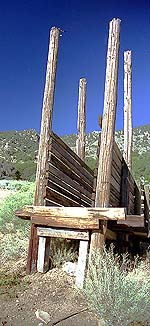 my
mules was a deer! That was the last deer season I packed for
Tommy. my
mules was a deer! That was the last deer season I packed for
Tommy.
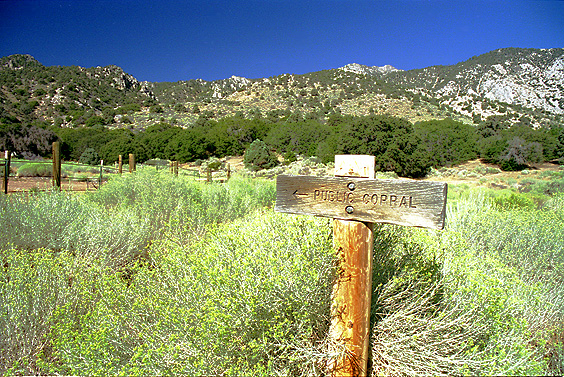
On this particular deer hunting party Tommy accompanied me down
to the public corrals at th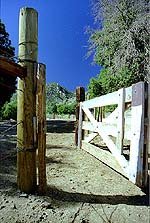 e
Olancha trail roadend in the stock truck and helped me pack up
the guests for the trip. He indicated that he was going to be
out of town when I came out of the mountains, a week later, but
that he would leave the stock truck at the roadend for me. Well,
out we came after a week and there was the stock truck. After
unpacking and unsaddling my mules I had lunch with the guests
at the roadend and bade them a fond farewell. Soon it dawned
on me that I was the only person at the roadend and that it was
highly unlikely that anyone else was going to show up this late
in the season; and, of course no one else ever did! What was
so tragic about this you might ask? The stock truck was rear
loading! Let me tell you that rear lift gate on the stock truck
was incredibly heavy. Getting it down wasn't the problem. After
I loaded all of the stock into the truck and the gear I had to
get that gate back up. I was darn stout then; and, try as I may
I was unable to get that gate any higher up then my head before
collapsing in pain. I finally decided the only way I was going
to get that thing up was to prop it up with poles of varying
lengths until I finally got it shut. Every time I nudged the
gate further shut, I would secure it in position with one of
my mule's halter ropes. After about 45 minutes I finally managed
to get the gate up and secured with the lift gate bolts. I was
never so worn out in my life, except for the week of shoveling
snow on Trail Crest Pass. It must have shown too. When I finally
rolled into Olancha the road was blocked for quite a while due
to road construction on U.S. 395 and a rancher pulled up along
side of me in a pickup truck and gave me two beers before heading
off somewhere. Ranchers and cowboys are just like that, don't
you know! e
Olancha trail roadend in the stock truck and helped me pack up
the guests for the trip. He indicated that he was going to be
out of town when I came out of the mountains, a week later, but
that he would leave the stock truck at the roadend for me. Well,
out we came after a week and there was the stock truck. After
unpacking and unsaddling my mules I had lunch with the guests
at the roadend and bade them a fond farewell. Soon it dawned
on me that I was the only person at the roadend and that it was
highly unlikely that anyone else was going to show up this late
in the season; and, of course no one else ever did! What was
so tragic about this you might ask? The stock truck was rear
loading! Let me tell you that rear lift gate on the stock truck
was incredibly heavy. Getting it down wasn't the problem. After
I loaded all of the stock into the truck and the gear I had to
get that gate back up. I was darn stout then; and, try as I may
I was unable to get that gate any higher up then my head before
collapsing in pain. I finally decided the only way I was going
to get that thing up was to prop it up with poles of varying
lengths until I finally got it shut. Every time I nudged the
gate further shut, I would secure it in position with one of
my mule's halter ropes. After about 45 minutes I finally managed
to get the gate up and secured with the lift gate bolts. I was
never so worn out in my life, except for the week of shoveling
snow on Trail Crest Pass. It must have shown too. When I finally
rolled into Olancha the road was blocked for quite a while due
to road construction on U.S. 395 and a rancher pulled up along
side of me in a pickup truck and gave me two beers before heading
off somewhere. Ranchers and cowboys are just like that, don't
you know!
|
Outposts
of the Past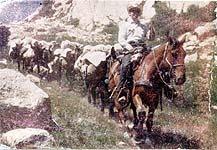
You will
have to excuse the poor quality of these images. All were taken
either before my 35mm camera days or taken by guests and later
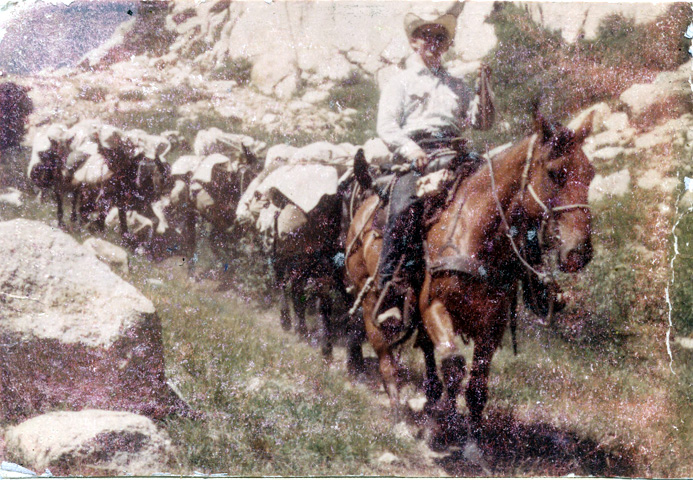
passed on to me. The Picture to the right is one of me seated
on Rich. My mules for the summer of 1966 were: Bart, Dan, Kate,
Bailey and Wendy. This was the first Sierra Club Family High
Trip offered by the Sierra Club. The route took us out of Twin
Lakes, in the Bridgeport area, over Rock Island Pass into Kerrick
Meadows down Kerrick Canyon and over Seavey Pass an on to Benson
Lake. (Since this was a family trip, the Clubbers only traveled
between 4 -7 miles per day. It was GREAT. On top of that, we
ended up retracing our path and going out the same way we came
in.) If you have never been to Benson Lake it is a sight to behold.
Here is this alpine lake with rock cliffs on the north and south
sides of the lake and a magnificent beach on the east end of
the lake. It is like nothing you'll ever encounter in the Sierra!
It's as if you've stumbled on the sandy shores of some ocean.
You just have to kick yourself to remind you that you are in
the High Sierra and not at Seal Beach in Southern California.
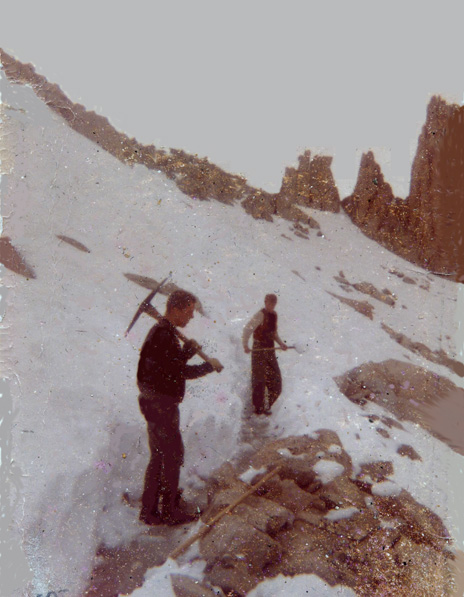
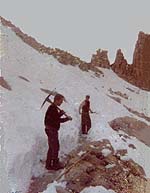 This next image, to the left, is one
of my brother Tom (with the pick ax) and Ed Brown shoveling out
Trail Crest Pass in June of 1965. I might have mentioned this
before, but we spent nearly a week camped just below Mirror Lake
at Bighorn Park on the Whitney Portal's trail to the summit of
Mt. Whitney. It rained every day and every day we saddle up and
rode to Trail Camp at 12,000'. From Trail Camp we hiked another
mile, and 50 switchbacks, with our pick axes and shovels up to
nearly 13,000' where the snow was and began shoveling snow for
6 hours. Ed swore he'd never smoke another cigarette after that,
but it was the first thing he lit up when we finally arrived
back at the Portal Store soaking wet and exhausted. We did discover
one useful thing on this trip: powdered Wyler's Lemonade mix
is excellent to start fires with when all you have is wet wood!
I'm not quite sure how the three of us stumbled on this little
known fact but it helped us stay dry during four days of rainy,
sleety, snow shoveling hell. One day we found ourselves shoveling
snow in a "white out" while it was snowing. Figure
it out - we were crazy soldiers following the commandants orders.
I think this was the huge straw that broke the back of my brother
for he never returned to Mt. Whitney Pack Trains after this year.
To me, it was worth every shovel since it eventually led to me
getting my own string of mules an packing with the outfit for
many summers. This next image, to the left, is one
of my brother Tom (with the pick ax) and Ed Brown shoveling out
Trail Crest Pass in June of 1965. I might have mentioned this
before, but we spent nearly a week camped just below Mirror Lake
at Bighorn Park on the Whitney Portal's trail to the summit of
Mt. Whitney. It rained every day and every day we saddle up and
rode to Trail Camp at 12,000'. From Trail Camp we hiked another
mile, and 50 switchbacks, with our pick axes and shovels up to
nearly 13,000' where the snow was and began shoveling snow for
6 hours. Ed swore he'd never smoke another cigarette after that,
but it was the first thing he lit up when we finally arrived
back at the Portal Store soaking wet and exhausted. We did discover
one useful thing on this trip: powdered Wyler's Lemonade mix
is excellent to start fires with when all you have is wet wood!
I'm not quite sure how the three of us stumbled on this little
known fact but it helped us stay dry during four days of rainy,
sleety, snow shoveling hell. One day we found ourselves shoveling
snow in a "white out" while it was snowing. Figure
it out - we were crazy soldiers following the commandants orders.
I think this was the huge straw that broke the back of my brother
for he never returned to Mt. Whitney Pack Trains after this year.
To me, it was worth every shovel since it eventually led to me
getting my own string of mules an packing with the outfit for
many summers.
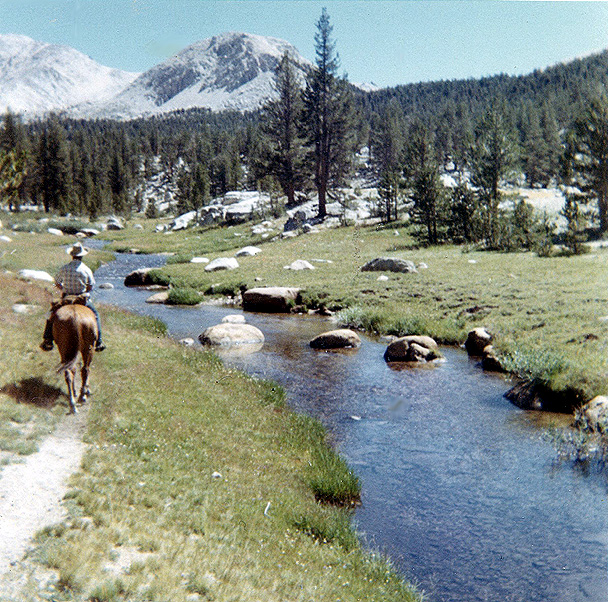
This last image, to the right, is one of me on Judy riding east
up Rock Creek towards the Miter Basin during 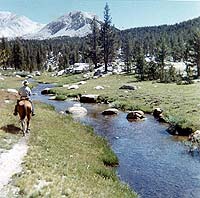 my
second trip with the Boyds and Merlos into the Sierra just west
of New Army and Cottonwood Passes. This was indeed a memorable
trip. I had an opportunity to once again be with a wonderful
girl, Cindy, that I had met previously when Charles Morgan packed
this same group of people into the Sierra. Cindy and I had developed
a great relationship corresponding with each other during the
college year and now we were finally able to see other once again.
We did have a terrific time together on this pack trip. Then
it was called the Hunt Party. Charles once again led this pack
trip, only this time I was a packer with a string of mules instead
a pot boy. It was nice having something to be proud of instead
of wondering if it was something I would ever achieve. Tommy
Jefferson was a great boss and good teacher though whom I was
quite proud of. I always looked forward at the end of each school
year to once again seeing Tommy's family and spending the summer
with them. I have so many exciting memories of Tommy,Barbara,
Norman, Susan and Kathy - but those are for another page. my
second trip with the Boyds and Merlos into the Sierra just west
of New Army and Cottonwood Passes. This was indeed a memorable
trip. I had an opportunity to once again be with a wonderful
girl, Cindy, that I had met previously when Charles Morgan packed
this same group of people into the Sierra. Cindy and I had developed
a great relationship corresponding with each other during the
college year and now we were finally able to see other once again.
We did have a terrific time together on this pack trip. Then
it was called the Hunt Party. Charles once again led this pack
trip, only this time I was a packer with a string of mules instead
a pot boy. It was nice having something to be proud of instead
of wondering if it was something I would ever achieve. Tommy
Jefferson was a great boss and good teacher though whom I was
quite proud of. I always looked forward at the end of each school
year to once again seeing Tommy's family and spending the summer
with them. I have so many exciting memories of Tommy,Barbara,
Norman, Susan and Kathy - but those are for another page. |
"1960 High Trip"
from 1960 Sierra Club Bulletin

|






 This page was last updated on
22 April 2024
This page was last updated on
22 April 2024